

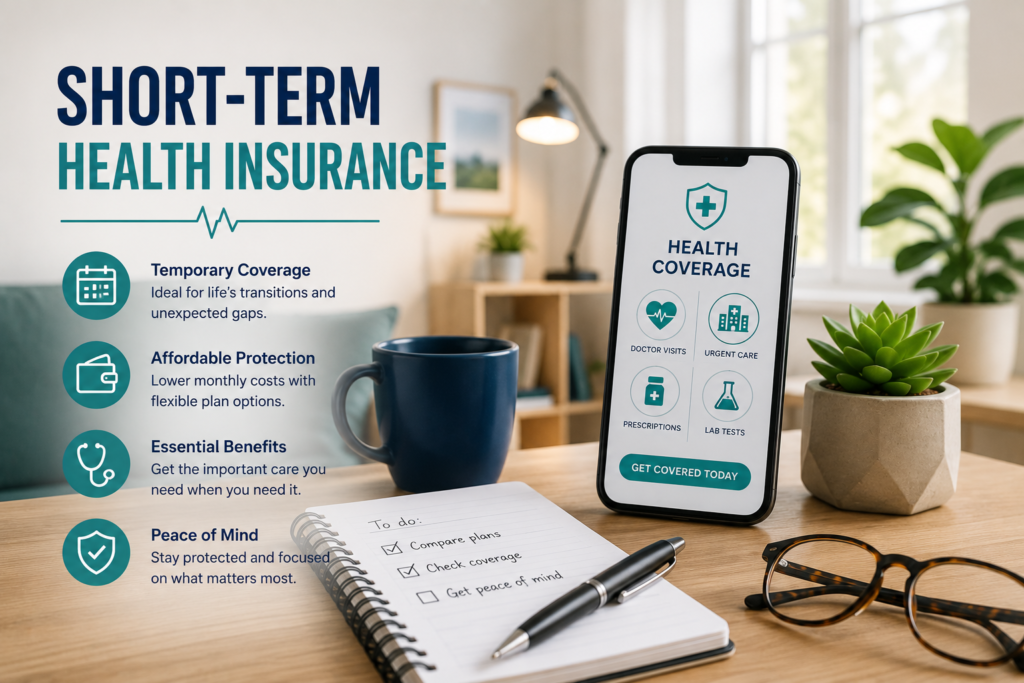
Short-term health insurance is built to bridge a gap, not replace comprehensive coverage — and that distinction matters more than almost anything else on this page. These plans aren’t regulated under the Affordable Care Act, which means they can deny you based on pre-existing conditions and aren’t required to cover things like maternity care, mental health services, or prescription drugs. In exchange, they’re often meaningfully cheaper than marketplace plans and can be purchased any time of year, with same-day approval in many cases. Here’s how the top short-term plans compare in 2026, and — just as importantly — who they’re actually right for.
Quick Answer: Best Short-Term Health Insurance Plans
| Company | Best For | Notes |
|---|---|---|
| Everest (FlexTerm) | Cheapest / Best Overall | Averages around $192/month for mid-tier coverage; includes mental health coverage |
| UnitedHealthcare (Golden Rule) | Best Plan Variety & Flexibility | Sold in 29 states; cancel anytime for free |
| National General / Allstate Health | Best for Applicants with Health Concerns | More flexible acceptance, though pre-existing conditions still excluded |
| Pivot Health | Best Flexible Coinsurance | Choice between 0% or 20% coinsurance on its Epic Base plan |
| Independence Insurance Company | No Fees / No Waiting Period | No application fees; among the cheapest available |
| Blue Cross Blue Shield | Best Established Brand Recognition | Widely recognized network name, though short-term offerings vary by state |
| Allianz Care | Best for International Coverage | Strong option if you also need coverage while traveling abroad |
| AXA | Best Global Customization | Flexible international add-ons alongside short-term domestic coverage |
*State availability, coverage limits, and pricing vary significantly — always confirm current details directly with the provider before enrolling.
What Short-Term Health Insurance Actually Is (and Isn’t)
It’s not ACA-compliant coverage. Short-term plans aren’t required to cover the ACA’s ten essential health benefits — inpatient and outpatient care, mental health services, prescription drugs, and maternity care among them. Coverage for these varies widely by plan, and many exclude them entirely.
You can be denied or charged more for pre-existing conditions. Unlike ACA marketplace plans, short-term insurers can medically underwrite your application, meaning a pre-existing condition can result in a denial, an exclusion for that condition, or a higher premium.
Plans can last up to 364 days, with renewal options up to 36 months total. Federal rules updated in September 2024 allow short-term plans to run for slightly under a year, with the option to renew for a combined total of up to three years, though your specific state may impose shorter limits.
Not every state allows them. Roughly 15 states, including California and New York, restrict or don’t allow short-term health insurance at all — check your state’s specific rules before assuming a plan is available to you.
Costs and structure vary enormously. Monthly premiums range from around $21 to $660 depending on the plan and coverage level, deductibles range from $1,000 to $25,000, and application fees range from $0 to $40.
Everest (FlexTerm) — Cheapest / Best Overall
Everest’s FlexTerm plan is frequently cited as the best overall value in short-term health insurance, averaging around $192 a month for a middle-of-the-road coverage tier ($5,000 deductible, $1 million maximum). It includes mental health coverage — not guaranteed on every short-term plan — and a $50 copay for wellness visits. Plan tiers range from Value Direct (up to $500,000 in coverage) to Copay and Elite options covering up to $2 million.
Pros:
- Frequently the cheapest option for comparable coverage
- Includes mental health coverage, uncommon among short-term plans
- Multiple plan tiers with coverage up to $2 million
Cons:
- Like all short-term plans, still excludes pre-existing conditions
- Availability varies by state
Best for: Cost-conscious shoppers who want the cheapest solid short-term option that still includes mental health coverage.
UnitedHealthcare (Golden Rule) — Best Plan Variety & Flexibility
UnitedHealthcare’s short-term plans, administered through Golden Rule Insurance, rank highly for plan variety, lower deductibles, and out-of-network coverage across most of its offerings. Plans are sold in 29 states, range from about $21 to $660 a month depending on coverage level, and — notably — can be canceled at any time for a full refund of unused premium, making it a flexible choice if you’re unsure exactly how long you’ll need coverage.
Pros:
- Wide range of plan options, including low-deductible choices
- Free cancellation at any time
- Strong out-of-network coverage in many plans
Cons:
- Only available in 29 states
- Wide price range means you’ll need to compare tiers carefully to find the right value
Best for: Shoppers who want maximum flexibility, including the ability to cancel penalty-free if their situation changes.
National General / Allstate Health — Best for Applicants with Health Concerns
National General (now operating under the Allstate Health brand) is frequently recommended for applicants who have some existing health concerns, since it tends to offer more flexible acceptance criteria than some competitors — though it’s important to understand that pre-existing conditions themselves generally still won’t be covered under the new short-term policy.
Pros:
- More flexible acceptance for applicants with some health history
- High coverage ceiling with low coinsurance across most plans
- Backed by the established Allstate brand
Cons:
- Pre-existing conditions are still excluded from coverage, even with more flexible acceptance
- Pricing can run higher than Everest for comparable coverage
Best for: Applicants who are concerned about being accepted at all due to some health history, understanding that pre-existing conditions won’t be covered regardless.
Pivot Health — Best Flexible Coinsurance
Pivot Health’s Epic Base policy stands out for giving shoppers a choice between 0% or 20% coinsurance, letting you directly control the tradeoff between a higher premium (with 0% coinsurance) and a lower premium (with 20% coinsurance and correspondingly higher potential out-of-pocket costs).
Pros:
- Direct choice between coinsurance levels to match your budget and risk tolerance
- Competitive overall pricing
- Straightforward plan structure
Cons:
- Coverage breadth is more basic than some higher-tier plans from competitors
- Like all short-term plans, excludes pre-existing conditions and essential health benefits not specifically included
Best for: Shoppers who want direct control over their coinsurance tradeoff rather than a fixed structure.
If you’re exploring your options Best Health Insurance for Freelancers and Gig Workers in 2026
Independence Insurance Company — No Fees / No Waiting Period
Independence Insurance Company stands out for charging no application fees and imposing no waiting periods, with plans that are among the cheapest available in the short-term market.
Pros:
- No application fees
- No waiting period before coverage begins
- Among the cheapest options available
Cons:
- Less brand recognition than larger national insurers
- Coverage breadth should be compared carefully against the lowest price
Best for: Budget-focused shoppers who want to avoid application fees and start coverage without delay.
Blue Cross Blue Shield — Best Established Brand Recognition
Blue Cross Blue Shield’s short-term offerings (where available, since BCBS operates through independent regional companies) benefit from the brand’s broad network recognition and established provider relationships, which can matter if network access is a bigger priority for you than the absolute lowest premium.
Pros:
- Strong brand recognition and established provider network
- Backed by the broader BCBS regional company infrastructure
- Familiar name for shoppers who already have BCBS coverage elsewhere
Cons:
- Short-term plan availability and specifics vary significantly by which regional BCBS company serves your state
- Not necessarily the cheapest option compared with dedicated short-term specialists like Everest
Best for: Shoppers who prioritize network name recognition and are willing to compare their specific state’s BCBS short-term offering directly.
Allianz Care — Best for International Coverage
Allianz Care is a strong option if your short-term coverage needs cross international lines — for example, if you’re bridging a domestic coverage gap while also traveling or working abroad — offering wide global network access alongside strong customer service.
Pros:
- Strong global network access
- Well-regarded customer service reputation
- Useful if you need coverage that extends beyond U.S. borders
Cons:
- May be more than necessary if you only need domestic short-term coverage
- Pricing and specifics vary by the international coverage scope you need
Best for: Shoppers who need short-term coverage that also extends internationally, such as digital nomads or workers with upcoming travel.
AXA — Best Global Customization
AXA offers strong customization options for short-term coverage that spans both domestic and international needs, making it a flexible choice for shoppers with more complex or cross-border coverage requirements.
Pros:
- Strong customization for combined domestic/international needs
- Established global insurer with broad network access
- Flexible add-ons to match specific travel or work situations
Cons:
- More complex than a purely domestic short-term plan if you don’t need international coverage
- Pricing reflects the broader scope of coverage available
Best for: Shoppers with cross-border coverage needs who want a highly customizable short-term option.
How We Chose These Companies {#how-we-chose}
InsureAtlas’s rankings are based on publicly available information: each provider’s disclosed plan tiers, coverage maximums, deductibles, coinsurance structures, and state availability, along with independent comparative analysis of short-term health insurance pricing and coverage breadth. No insurer can pay to appear higher on this list, and our rankings are not based on affiliate commission rates. Because short-term plan availability and specific terms vary enormously by state, and because these plans are not standardized the way ACA-compliant plans are, we strongly recommend reading the actual policy document — not just the marketing summary — before enrolling.
Is Short-Term Health Insurance Right for You?
Good fit: You’re between jobs and temporarily without employer coverage, waiting for a new job’s benefits to kick in, missed ACA open enrollment without a qualifying life event, or you’re generally healthy and want a cheaper bridge for a defined, short period.
Poor fit: You have an ongoing health condition that needs regular treatment or medication, you might need maternity care during the coverage period, or you’re looking for a long-term, primary health insurance solution rather than a genuine bridge between comprehensive plans.
Always check your state’s specific rules first. Availability, maximum duration, and renewal rules vary significantly by state — some states restrict short-term plans heavily or don’t allow them at all.
Read the exclusions list carefully, not just the premium. Two plans that look similarly priced can have very different real-world coverage once you compare what’s actually excluded.
Frequently Asked Questions
Is short-term health insurance the same as ACA marketplace insurance? No. Short-term plans aren’t required to comply with ACA rules, meaning they can deny or exclude pre-existing conditions and aren’t required to cover the ACA’s essential health benefits, such as maternity care, mental health services, and prescription drugs.
How long can a short-term health insurance plan last? Under federal rules updated in September 2024, short-term plans can run for up to 364 days, with the option to renew for a combined total of up to 36 months — though individual states can impose shorter limits, and some states don’t allow short-term plans at all.
Can I get short-term health insurance if I have a pre-existing condition? You may be able to get a policy, but coverage for that specific pre-existing condition will likely be excluded or subject to a higher premium, since short-term insurers can medically underwrite applications, unlike ACA marketplace plans.
Is short-term health insurance available in every state? No. Roughly 15 states, including California and New York, restrict or don’t allow short-term health insurance plans at all — check your specific state’s rules before assuming a plan is available to you.
How much does short-term health insurance typically cost? Monthly premiums commonly range from about $21 to $660 depending on the plan, coverage level, and deductible chosen, with deductibles ranging from $1,000 to $25,000 across the market — comparing total coverage and exclusions matters as much as the premium itself.
Bottom Line
Everest stands out as the strongest overall value for most shoppers, combining low cost with mental health coverage that many competitors don’t include. UnitedHealthcare’s Golden Rule plans are worth a look if flexibility and free cancellation matter most to you, while National General/Allstate Health is a reasonable option if you’re worried about acceptance due to some health history. Whichever plan you choose, remember what short-term insurance is designed for: bridging a specific, temporary gap — not replacing comprehensive coverage if you have ongoing health needs or expect to need care outside what these plans typically cover.
This article is for general informational purposes only and does not constitute medical, financial, legal, or insurance advice. Coverage availability, plan terms, exclusions, and state regulations vary and are subject to change. Always read the full policy document and confirm current details directly with the insurance company or a licensed agent before purchasing.