
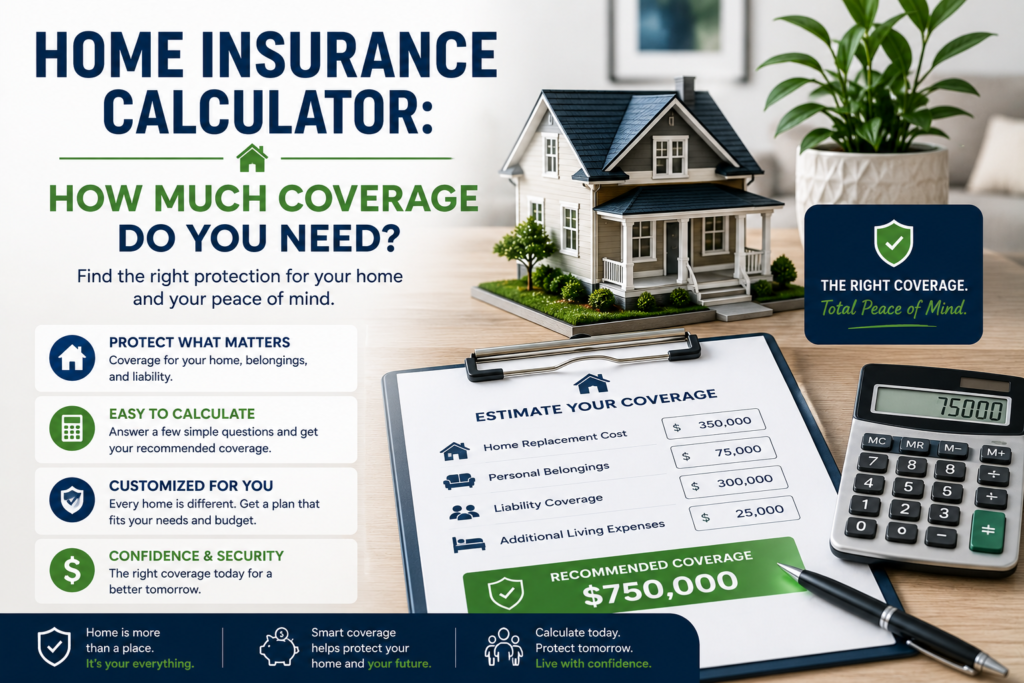
The most common home insurance mistake isn’t choosing the wrong company — it’s insuring your home for the wrong amount. A lot of homeowners default to their purchase price or their home’s market value, but neither one reflects what it would actually cost to rebuild the structure, replace everything inside it, or cover you if someone is injured on your property. Use the calculator below to get a personalized starting estimate, then read on to understand how each part of the number is built.
The Four Coverage Types That Make Up Your Policy
Dwelling coverage (Coverage A) pays to rebuild your home’s structure if it’s destroyed. This should be based on replacement cost — what it would actually cost to rebuild today — not your home’s market value or what you paid for it. These numbers can differ significantly, especially in areas where land value makes up a large share of the purchase price, or where labor and material costs have risen faster than home prices.
Personal property coverage (Coverage C) pays to replace your belongings — furniture, electronics, clothing, appliances — after a covered loss. It’s commonly set as a percentage of your dwelling coverage, typically in the 50-70% range, though your actual belongings’ value could be higher or lower than that default.
Liability coverage (Coverage E) protects you financially if someone is injured on your property, or if you’re found responsible for damage to someone else’s property, including the cost of a legal defense if you’re sued. Standard policies often default to a relatively modest amount, but many homeowners are underinsured here relative to their actual financial exposure.
Additional living expenses / loss of use (Coverage D) pays for temporary housing, meals, and other extra costs if your home becomes uninhabitable after a covered loss while it’s being repaired or rebuilt. This is commonly set around 20-30% of your dwelling coverage.
Quick Answer: Rule-of-Thumb Estimate
If you want a fast starting point before using the calculator: multiply your home’s square footage by your local cost to rebuild per square foot (commonly somewhere between $100 and $400+ depending on your region, home quality, and current construction costs) to estimate dwelling coverage. Then add roughly 60% of that figure for personal property, 20-25% for additional living expenses, and choose a liability limit based on your assets and risk exposure — often at least $300,000, with more for higher-net-worth households.
Getting Dwelling Coverage Right
This is the number that matters most, since your personal property and additional living expenses coverage are typically calculated as a percentage of it. A few ways to get a more accurate estimate than a flat rule of thumb:
- Get a professional replacement cost estimate. Many insurers and independent appraisers can calculate this based on your home’s specific square footage, materials, and local construction costs — more accurate than a generic per-square-foot estimate.
- Account for unique features. Custom finishes, additions, high ceilings, and complex rooflines all increase rebuilding cost beyond what a basic square-footage calculation would suggest.
- Revisit this number regularly. Construction costs have risen significantly in recent years — a dwelling coverage amount that was accurate three years ago may now be too low to fully rebuild your home.
- Understand guaranteed vs. extended vs. standard replacement cost. Guaranteed replacement cost pays whatever it actually costs to rebuild, even above your policy limit; extended replacement cost pays up to a set percentage above your limit (often 25-50%); standard replacement cost pays up to your stated limit only. This distinction matters a lot if rebuilding costs spike after your policy is written.
Estimating Personal Property Coverage
Rather than relying purely on the default 50-70% of dwelling coverage, consider doing a rough home inventory:
- Walk through each room and estimate the replacement cost (not the resale value) of your furniture, electronics, appliances, and clothing
- Don’t forget less obvious categories: kitchenware, linens, tools, seasonal decorations, and items in storage areas like a garage or attic
- Check for sub-limits on jewelry, art, and collectibles — standard policies often cap these categories at a modest amount, which may require a separate scheduled endorsement if your actual value is higher
Choosing the Right Liability Limit
A standard policy might default to $100,000-$300,000 in liability coverage, but many financial professionals recommend considering higher limits — often starting around $300,000-$500,000 — especially if you have significant assets, a pool, trampoline, or dog breed considered higher-risk by insurers, all of which can increase your liability exposure. If your assets exceed your home policy’s liability limit, a personal umbrella policy can provide substantial additional coverage (often $1 million or more) at a relatively modest additional cost.
Sizing Additional Living Expenses (Loss of Use)
Think through how long it would realistically take to rebuild or repair your home after a major loss, and what temporary housing, meals, and related costs would run during that period in your area. The common 20-30% of dwelling coverage default works reasonably well for most homeowners, but it’s worth adjusting upward if you live in an area where temporary housing costs are especially high, or where rebuilding after a major regional event (like a hurricane) could take considerably longer due to contractor demand.
Frequently Asked Questions
Should my home insurance coverage match my home’s market value? No. Home insurance dwelling coverage should be based on replacement cost — what it would actually cost to rebuild the structure — not market value, which includes land value and local real estate demand that have nothing to do with rebuilding costs.
How much personal property coverage do I actually need? A common default is 50-70% of your dwelling coverage amount, but a rough home inventory — walking through each room and estimating replacement costs — will give you a more accurate, personalized number than relying purely on the default percentage.
Is $300,000 in liability coverage enough? It depends on your assets and risk factors. Many financial professionals suggest starting around $300,000-$500,000, with higher limits or a personal umbrella policy for households with significant assets, higher-risk property features (like a pool), or other factors that increase liability exposure.
How often should I update my home insurance coverage amount? Revisit your coverage after any major renovation, and consider a general check-in every 2-3 years even without one, since construction costs and your home’s replacement value can rise meaningfully over time even if you haven’t made any changes.
What’s the difference between guaranteed, extended, and standard replacement cost coverage? Guaranteed replacement cost pays whatever it actually costs to rebuild, even if it exceeds your policy limit. Extended replacement cost pays up to a set percentage (commonly 25-50%) above your limit. Standard replacement cost pays only up to your stated coverage limit, which can leave a gap if rebuilding costs have risen since you bought the policy.

Bottom Line
A quick square-footage estimate is a reasonable starting point, but the calculator above — which builds out dwelling, personal property, liability, and additional living expenses together — gives a far more complete picture of what your policy should actually include. Use it to get your numbers, then compare quotes from a few insurers with those figures in hand rather than accepting whatever coverage amount a quote defaults to. If your home has unique features, a high-value collection, or significant liability exposure, it’s worth a conversation with a licensed agent in addition to running the numbers yourself.