
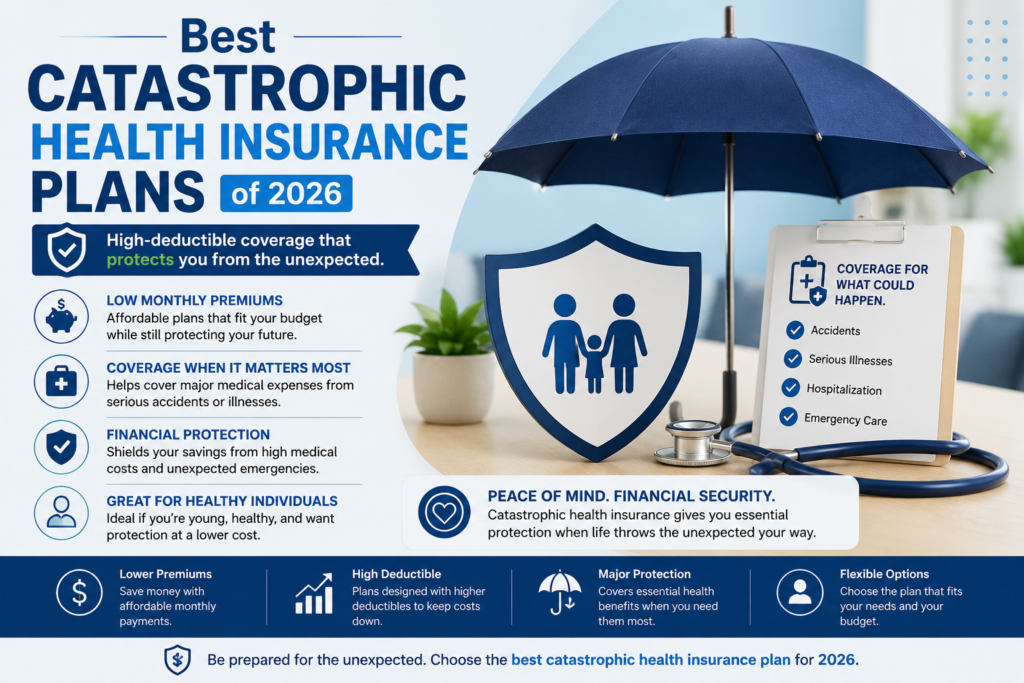
Catastrophic health plans have quietly become available to a lot more people in 2026. Historically, these plans were mostly limited to adults under 30, with anyone older needing a specific hardship or affordability exemption to qualify. In response to this year’s steep marketplace premium increases, the Centers for Medicare & Medicaid Services expanded hardship exemption guidance so that adults 30 and older who don’t qualify for premium tax credits or cost-sharing reductions because their income falls below 100% or above 400% of the federal poverty level can now access catastrophic coverage too. It’s a genuinely significant change, and it’s proven politically contested — a coalition of 19 state attorneys general formally opposed the expansion, arguing these plans leave consumers with too much financial exposure. Here’s what to know before considering one.
Quick Answer: Best Catastrophic Health Insurance Options
| Provider / Strategy | Best For | Notes |
|---|---|---|
| Blue Cross Blue Shield | Best Nationwide Availability | Widest state-by-state catastrophic plan access |
| Kaiser Permanente | Best Integrated Care Where Available | Strong pediatric and preventive care, limited states |
| Ambetter | Best Budget Option | Frequently priced below legacy national carriers |
| Oscar Health | Best Digital-First Experience | Strong telehealth focus |
| Molina Healthcare | Best Value in Expansion States | Competitive low-premium focus |
| Catastrophic + HSA | Best New Strategy for 2026 | Newly HSA-eligible starting this plan year |
| Expanded hardship exemption | Newly Eligible Adults 30+ | Applies if income is below 100% or above 400% FPL and you don’t qualify for subsidies |
| Health sharing plans | Lower-Cost Alternative, Use With Caution | Not actual insurance — no guaranteed coverage |
*Availability, eligibility, and pricing vary by state and individual circumstances — always confirm current details before enrolling.
What a Catastrophic Plan Actually Is
Very low premiums, very high deductibles. In 2026, catastrophic plans carry an annual deductible of $10,600 for an individual or $21,200 for a family — among the highest allowed on the ACA marketplace, which is exactly why premiums run so much lower than other metal tiers.
They still cover ACA essential health benefits. Despite the high deductible, catastrophic plans are ACA-compliant and must cover the same essential health benefits as other marketplace plans, plus certain preventive care at no cost regardless of whether you’ve met your deductible.
At least three primary care visits are covered before the deductible applies. This is a specific, guaranteed feature of catastrophic plans — you’re not paying full price out of pocket for basic primary care visits even before you hit your deductible.
Once you hit the deductible, you’re covered 100%. After meeting the deductible, catastrophic plans cover approved costs in full for the rest of the year, with no additional copays or coinsurance — genuinely «catastrophic» protection once a serious health event happens.
Eligibility has historically been limited — until this year. Adults under 30 could always buy a catastrophic plan without extra requirements. Adults 30 and older needed an approved hardship or affordability exemption — and starting in 2026, that exemption has been specifically expanded to cover more people affected by this year’s premium increases.
Blue Cross Blue Shield — Best Nationwide Availability
Blue Cross Blue Shield offers catastrophic plans through its network of independent regional companies in more states than most competitors, making it the most consistently available option for shoppers checking whether a catastrophic plan exists in their specific area.
Pros:
- Widest overall state-by-state availability for catastrophic coverage
- Backed by broad, established provider networks
- Strong brand recognition if you’ve used BCBS coverage before
Cons:
- Because BCBS operates through independent regional companies, exact plan design and pricing vary by state
- Not necessarily the cheapest option compared with regional carriers in overlapping markets
Best for: Shoppers who want the broadest chance of finding a catastrophic plan available in their specific state.
Kaiser Permanente — Best Integrated Care Where Available
Kaiser Permanente’s catastrophic offering benefits from the same integrated care model that earns it top marks across other metal tiers, making it a strong option for eligible shoppers in Kaiser’s roughly eight operating states plus D.C. who want strong preventive care built into a low-premium plan.
Pros:
- Strong integrated care model and preventive care focus
- Consistently high customer satisfaction across Kaiser’s plan offerings generally
- Streamlined digital tools for managing appointments and care
Cons:
- Only available in a limited number of states
- HMO structure generally requires using Kaiser’s own network
Best for: Eligible shoppers in Kaiser’s operating states who want a catastrophic plan backed by a highly rated integrated system.
Ambetter — Best Budget Option
Ambetter is frequently priced competitively relative to legacy national carriers across marketplace metal tiers, and its catastrophic offerings follow the same pattern — a reasonable first comparison point for shoppers focused purely on the lowest possible premium.
Pros:
- Frequently competitive pricing relative to legacy carriers
- Available in a substantial number of states
- Straightforward marketplace plan structure
Cons:
- Network breadth can be narrower than larger legacy insurers in some areas
- Customer satisfaction scores are solid but trail top performers like Kaiser
Best for: Budget-focused shoppers who qualify for catastrophic coverage and want the lowest realistic premium.
Oscar Health — Best Digital-First Experience
Oscar Health’s telehealth-forward, app-based approach carries over into its catastrophic plan offerings, appealing to shoppers who want a modern digital experience alongside the lowest-tier marketplace premium.
Pros:
- Strong telehealth and virtual care focus
- Modern, easy-to-use digital tools
- Often competitively priced relative to legacy carriers
Cons:
- Network breadth can be narrower than legacy insurers like BCBS in some areas
- Availability is more limited than the largest national carriers
Best for: Shoppers who want a digital-first plan experience alongside catastrophic-level coverage.
If you’re exploring your options Best Health Insurance for Self-Employed Workers in 2026

Molina Healthcare — Best Value in Expansion States
Molina Healthcare’s low-premium, value-based focus extends to its catastrophic plan offerings, particularly in states where it also operates Medicaid managed care plans — useful if your income situation might shift between catastrophic marketplace coverage and Medicaid eligibility over time.
Pros:
- Strong focus on low-premium coverage
- Available across ACA, Medicaid, and Medicare Advantage in many states — useful if your income fluctuates
- Available in a substantial number of states
Cons:
- Network breadth is narrower than larger national insurers in some areas
- Less brand recognition than legacy insurers like BCBS
Best for: Shoppers whose income may fluctuate near Medicaid eligibility thresholds and want an insurer active across multiple program types.
Catastrophic + HSA — Best New Strategy for 2026
Starting in 2026, you can contribute to a Health Savings Account if you have a catastrophic plan purchased through the marketplace and no additional health coverage — a genuinely new option that wasn’t previously available with this plan type. Pairing the two lets eligible shoppers combine a very low premium with pre-tax savings for future medical costs.
Pros:
- Newly available HSA eligibility starting with 2026 catastrophic plans
- Combines a low premium with tax-advantaged medical savings
- Particularly useful for healthy individuals who rarely need care
Cons:
- Still requires meeting a very high deductible ($10,600 individual / $21,200 family) before most coverage applies
- Not the best strategy if you expect to need regular medical care during the year
Best for: Generally healthy, eligible shoppers who want to combine the lowest premium tier with an HSA savings strategy.
The Expanded 2026 Hardship Exemption — Newly Eligible Adults 30+
This is less a specific provider and more a critical eligibility change worth understanding on its own: for 2026, CMS expanded hardship exemption guidance specifically because of this year’s steep premium increases. Adults 30 and older who are projected to be ineligible for premium tax credits or cost-sharing reductions — generally because their income falls below 100% or above 400% of the federal poverty level — may now qualify for a hardship exemption that allows them to purchase catastrophic coverage, a option that wasn’t available to this group in the same way in recent years.
Pros:
- Opens catastrophic coverage to a meaningfully larger group of adults 30 and older
- Directly responds to this year’s steep premium increases for people who don’t qualify for subsidies
- Can be purchased on or off the exchange once the exemption is confirmed
Cons:
- Politically contested — a coalition of 19 state attorneys general has formally opposed this expansion, arguing catastrophic plans leave consumers with too much financial exposure
- Still carries the same very high deductible as catastrophic plans generally
Best for: Adults 30+ who don’t qualify for APTC or CSR based on projected income and have been priced out of standard marketplace plans by this year’s increases.
Health Sharing Plans — Lower-Cost Alternative, Use With Caution
Health sharing programs — including plans like Altrua RUBY or JHS Community Health Share — are sometimes marketed as catastrophic-style alternatives, often at a lower cost and with fewer eligibility restrictions than ACA catastrophic plans. As with every mention of this option in our other guides, it’s essential to understand clearly: these are not insurance, and no specific claim is legally guaranteed to be covered.
Pros:
- Often lower cost than ACA catastrophic plans
- Fewer eligibility restrictions than the ACA marketplace’s hardship exemption requirements
Cons:
- Not insurance — no legal guarantee that a specific claim will be paid
- Coverage for pre-existing conditions and certain treatments is commonly excluded or limited
Best for: Shoppers who fully understand the distinction from real insurance and are comfortable with the lack of guaranteed coverage as a tradeoff for lower cost.
How We Chose These Options {#how-we-chose}
InsureAtlas’s overview is based on publicly available information: CMS guidance on catastrophic plan eligibility and the 2026 hardship exemption expansion, ACA marketplace deductible and coverage rules, and general market data on carrier availability for catastrophic plans by state. No insurer can pay to appear higher on this list, and our rankings are not based on affiliate commission rates. This is also a genuinely contested policy area — we’ve aimed to present the expanded eligibility change, and the pushback against it, evenhandedly rather than advocating for or against the underlying policy.
Is a Catastrophic Plan Right for You?
Good fit: You’re generally healthy, rarely need medical care beyond preventive visits, and either qualify under the standard under-30 rule or the expanded 2026 hardship exemption for older adults priced out of subsidized coverage.
Poor fit: You have an ongoing health condition requiring regular treatment, expect significant medical expenses this year, or would struggle to cover a $10,600+ deductible out of pocket if a serious health event occurred.
Always compare against Bronze plans directly. Since both are now HSA-eligible in 2026 and catastrophic plans and Bronze plans cover similar levels of costs for a standard population, it’s worth comparing the specific premium and deductible tradeoff rather than assuming catastrophic is automatically the better low-cost option.
Understand this is a genuinely debated policy area. The expanded eligibility for 2026 is new, and critics — including a coalition of state attorneys general — argue it exposes more consumers to plans with minimal coverage until a very high deductible is met. Weigh this alongside your own financial situation and risk tolerance.
Frequently Asked Questions
What is the 2026 deductible for a catastrophic health plan? $10,600 for an individual or $21,200 for a family — among the highest deductibles allowed on the ACA marketplace, which is why catastrophic plans carry lower premiums than other metal tiers.
Who can buy a catastrophic health plan in 2026? Adults under 30 can generally purchase one without additional requirements. Adults 30 and older need an approved hardship or affordability exemption — and starting in 2026, that exemption has been expanded to cover more people whose projected income (below 100% or above 400% FPL) makes them ineligible for premium tax credits or cost-sharing reductions.
Can I use an HSA with a catastrophic health plan? Yes, starting in 2026 — this is a new change. If you have a catastrophic plan purchased through the marketplace and no additional health coverage, you can contribute to a Health Savings Account.
Is a catastrophic plan the same as a Bronze plan? They’re similar in the level of costs they cover for a typical population, but catastrophic plans have higher deductibles and historically stricter eligibility rules, and they sit in a separate risk pool from metal-tier plans for the ACA’s risk adjustment program — a technical distinction that mainly affects insurers rather than consumers directly.
Why is the 2026 catastrophic plan expansion controversial? CMS expanded hardship exemption access specifically in response to this year’s steep marketplace premium increases, but a coalition of 19 state attorneys general has formally opposed the change, arguing that catastrophic plans provide minimal coverage and leave consumers with significant out-of-pocket exposure before meaningful coverage begins.
Bottom Line
Catastrophic plans remain a narrow but genuinely useful option for specific situations: generally healthy shoppers under 30, or — new for 2026 — older adults priced out of subsidized coverage by this year’s premium increases. Blue Cross Blue Shield offers the broadest availability if you’re checking whether a plan exists in your state, while Kaiser, Ambetter, Oscar, and Molina are worth comparing directly on price and network. Before enrolling, compare a catastrophic plan against a Bronze plan with similar coverage, and be honest with yourself about whether you could actually afford the deductible if a serious health event happened this year — that’s the real question this plan type is built around.
This article is for general informational purposes only and does not constitute medical, financial, legal, or tax advice. Coverage availability, eligibility rules, deductibles, and program details vary by state and are subject to change, including potential further regulatory or legal developments regarding the 2026 hardship exemption expansion. Always confirm current details directly through your state’s official health insurance marketplace or a licensed insurance agent before enrolling.