
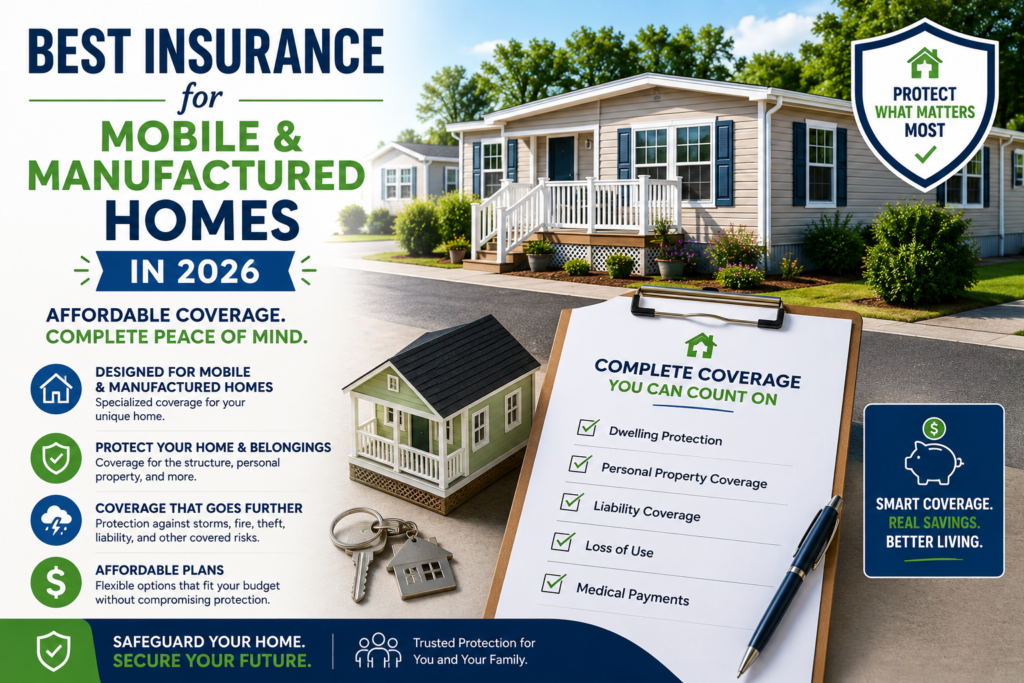
Fewer national insurers write policies for mobile and manufactured homes than for traditional site-built homes, and the ones that do apply different underwriting rules — age limits, tie-down requirements, and specific transit coverage rules that don’t come up with a standard homeowners policy. That narrower field of options makes it worth knowing exactly which insurers specialize in this category before you start shopping, rather than assuming your usual home insurer writes this type of coverage at all. Here’s how the top options compare in 2026.
Quick Answer: Best Mobile & Manufactured Home Insurance
| Company | Best For | Notes |
|---|---|---|
| American Family | Best Overall | Top claims satisfaction; strong discount lineup |
| Foremost | Best for Older/Specialty Homes | First insurer built specifically for mobile homes; AARP partnership |
| State Farm | Best Widely Available Option | Extensive agent network; strong bundling |
| Allstate | Best Coverage Options | Scheduled personal property; 30-day in-transit coverage available |
| Farmers | Best Similar-to-Standard Coverage | Coverage structure close to a typical homeowners policy |
| American Modern | Best Specialty Insurer | Focused specifically on manufactured housing |
| GEICO | Best for Bundling with Auto | Home policies issued through partner insurers |
| Progressive | Best for Comparing Multiple Quotes | Wide availability for easy side-by-side shopping |
*Availability, age restrictions, and pricing vary significantly by state and specific home — always confirm current underwriting guidelines directly with the carrier.
Mobile Home vs. Manufactured Home: What’s the Difference?
The terms are often used interchangeably, but there’s a specific legal distinction: if the home was built before June 15, 1976, the U.S. Department of Housing and Urban Development classifies it as a mobile home; if built after that date, under HUD’s federal building code, it’s a manufactured home. This date matters for insurance because older mobile homes (pre-1976) face more limited insurer options and typically higher rates, since they were built before current federal construction and safety standards took effect.
What Makes This Type of Insurance Different
Mobile and manufactured home insurance (sometimes called an HO-7 policy) covers the same basic categories as standard homeowners insurance — dwelling, personal property, and liability — but with underwriting and coverage details specific to manufactured housing:
- Age restrictions. Many insurers now decline units older than 25 years, and pre-1976 mobile homes face even more limited options.
- Tie-down and anchoring requirements. Insurers commonly verify that a home’s tie-down or anchoring system meets current standards, since this affects the home’s ability to withstand wind events.
- Transit coverage is usually separate. Standard mobile home policies generally do not cover the home while it’s actively being transported — some insurers, like Allstate, offer optional 30-day coverage specifically for moving the home to a new location.
- Replacement cost matters more than ever. Because the cost of new manufactured homes has risen significantly, many experts now recommend replacement cost coverage over actual cash value, despite the higher premium, to avoid being underinsured if you need to rebuild.
American Family — Best Overall
American Family is widely regarded as the best overall option for most manufactured homeowners, combining a strong lineup of available discounts with a high score on independent claims satisfaction surveys and roughly half the complaint volume of an average insurer its size. One notable gap: American Family’s basic policy doesn’t include replacement cost coverage, so ask specifically if that matters to you.
Pros:
- High claims satisfaction scores and low complaint volume
- Strong lineup of available discounts
- Unique coverage upgrades, including hidden water leak damage
Cons:
- Basic policy doesn’t include replacement cost coverage — must be added or confirmed separately
- Available in a more limited number of states than the largest national carriers
Best for: Manufactured homeowners who prioritize claims service and want a strong overall discount lineup.
Foremost — Best for Older/Specialty Homes
Foremost was the first insurance company built specifically to insure mobile homes, and it maintains that specialty focus today, including a large partnership serving AARP members. It’s a strong first call if your home is older or doesn’t fit standard underwriting criteria at more generalist insurers.
Pros:
- Purpose-built for mobile and manufactured homes since its founding
- Strong option for older homes that other insurers may decline
- Large-scale partnership network, including AARP
Cons:
- More specialized focus means less flexibility for combining with unrelated policy types
- Pricing reflects the specialty, higher-risk focus in some cases
Best for: Owners of older mobile homes or homes that have been declined by more generalist insurers.
State Farm — Best Widely Available Option
State Farm offers manufactured home insurance backed by its extensive local agent network, making it a practical choice for homeowners who want in-person guidance alongside solid bundling discounts if they also insure a vehicle or other property with State Farm.
Pros:
- Extensive local agent network for hands-on support
- Strong bundling discounts across policy types
- Broad availability across most states
Cons:
- Not specifically marketed as a mobile-home specialist the way Foremost is
- Underwriting for older units may be more conservative than dedicated specialty insurers
Best for: Manufactured homeowners who want local agent support and bundling options from a familiar national insurer.
Allstate — Best Coverage Options
Allstate’s manufactured home policy includes standard liability, injury, and property damage coverage, plus optional add-ons that stand out in this category — including scheduled coverage for higher-value personal property and 30-day collision coverage that protects the home specifically while it’s being transported to a new location.
Pros:
- Optional in-transit coverage for moving the home, uncommon among competitors
- Scheduled personal property coverage available for valuable belongings
- Strong digital tools for managing the policy
Cons:
- Base policy pricing can run higher than budget-focused competitors
- Complaint levels have historically been higher than top-ranked insurers like American Family
Best for: Manufactured homeowners who anticipate moving their home or want more extensive optional coverage add-ons.
Farmers — Best Similar-to-Standard Coverage
Farmers structures its mobile and manufactured home coverage very similarly to its standard homeowners insurance — covering the structure, personal belongings, and liability — which can make it an easier policy to understand for homeowners already familiar with typical home insurance. It also offers a range of standard discounts, including bundling and non-smoking discounts.
Pros:
- Coverage structure closely mirrors standard homeowners insurance
- Solid range of available discounts
- Wide availability, including specialty markets like Florida
Cons:
- Customer satisfaction scores have been below average in some independent surveys
- Not the cheapest option in every state
Best for: Manufactured homeowners who want coverage that feels familiar and closely mirrors a standard homeowners policy.
American Modern — Best Specialty Insurer
American Modern focuses specifically on manufactured housing as one of its core specialty lines, offering coverage tailored to the unique risks of this property type rather than treating it as an afterthought within a broader homeowners product lineup.
Pros:
- Deep specialty focus on manufactured housing specifically
- Coverage options tailored to the category’s unique risks
- Long-established reputation in the specialty insurance space
Cons:
- Less brand recognition than large national insurers
- Typically sold through independent agents rather than direct online quotes
Best for: Manufactured homeowners who want a true specialty insurer rather than a generalist offering a manufactured-home product on the side.
GEICO — Best for Bundling with Auto
GEICO offers manufactured home insurance through partner carriers, letting homeowners bundle with GEICO auto insurance for additional savings through an easy-to-use digital platform, even though GEICO itself doesn’t directly underwrite the home policy.
Pros:
- Convenient bundling with GEICO auto insurance
- Easy digital quote and policy management
- Access to specialty underwriting through partner carriers
Cons:
- Doesn’t underwrite its own manufactured home policies — terms depend on the partner insurer
- Coverage details can vary more than with a direct specialty carrier
Best for: Manufactured homeowners who already have GEICO auto insurance and want a simple bundled quote.
Progressive — Best for Comparing Multiple Quotes
Progressive’s wide availability and straightforward online quoting process make it an easy option to include when comparing multiple manufactured home insurance quotes side by side, even if it isn’t always the cheapest or most specialized choice.
Pros:
- Wide availability for easy quote comparison
- Straightforward online process
- Solid bundling options with Progressive auto insurance
Cons:
- Less specialized in manufactured housing than dedicated specialty insurers
- Coverage details may be underwritten through partner carriers depending on your state
Best for: Homeowners who want a fast comparison quote alongside more specialized manufactured home insurers.
How We Chose These Companies {#how-we-chose}
InsureAtlas’s rankings are based on publicly available information: each carrier’s disclosed underwriting approach to mobile and manufactured homes (age limits, tie-down requirements, transit coverage), third-party financial-strength ratings (AM Best), independent consumer satisfaction and complaint data, and published average premium comparisons. No insurer can pay to appear higher on this list, and our rankings are not based on affiliate commission rates. Because underwriting rules and pricing for mobile and manufactured homes vary enormously by insurer, home age, and state, we recommend getting quotes from at least three carriers — including at least one specialty insurer — before deciding.
How to Get the Best Mobile/Manufactured Home Insurance
Know your home’s exact classification and age. Confirm whether your home is classified as «mobile» (pre-1976) or «manufactured» (post-1976) and its exact age — this affects which insurers will even quote you, given common 25-year age cutoffs at many carriers.
Verify your tie-down/anchoring system meets current standards. Insurers commonly check this as part of underwriting, and an outdated or improperly installed system can affect both eligibility and pricing.
Choose replacement cost coverage if you can. Given how much new manufactured home costs have risen, actual cash value coverage (which factors in depreciation) can leave you significantly underinsured relative to what it would actually cost to replace your home today.
Ask specifically about in-transit coverage if you plan to move the home. Standard policies generally don’t cover the home while it’s being transported — confirm whether your insurer offers a specific add-on, like Allstate’s 30-day transit coverage, if a move is in your plans.
Get quotes from at least three insurers, including a specialty carrier. Pricing and underwriting flexibility vary more for mobile/manufactured homes than for standard site-built homes — a specialty insurer like Foremost or American Modern may offer options a generalist insurer won’t.
Frequently Asked Questions
What’s the difference between a mobile home and a manufactured home for insurance purposes? Homes built before June 15, 1976 are classified as mobile homes, while those built after that date under HUD’s federal building code are classified as manufactured homes. Pre-1976 mobile homes generally face more limited insurer options and higher rates.
How much does mobile home insurance typically cost? Annual premiums commonly range from about $700 to $1,500, though homes in hurricane- or tornado-prone states can run significantly higher due to increased wind and hail risk.
Does mobile home insurance cover the home while it’s being moved? Generally, no — standard policies typically exclude coverage while the home is in transit. Some insurers, including Allstate, offer optional short-term coverage (commonly around 30 days) specifically for moving the home to a new location.
Is there an age limit for insuring a mobile or manufactured home? Many insurers now decline homes older than 25 years, and options narrow further for homes built before 1976. Specialty insurers like Foremost and American Modern are generally more willing to work with older units than generalist insurers.
Should I get replacement cost or actual cash value coverage for my manufactured home? Many experts now recommend replacement cost coverage despite the higher premium, since the cost of new manufactured homes has risen significantly — actual cash value coverage, which factors in depreciation, can leave you underinsured relative to today’s replacement costs.
Bottom Line
American Family stands out as the strongest overall option for most manufactured homeowners, combining solid discounts with top-tier claims satisfaction, while Foremost and American Modern are worth a direct look if your home is older or doesn’t fit standard underwriting criteria. If you’re planning to move your home, Allstate’s optional transit coverage is a detail worth asking about specifically. Whichever insurer you choose, confirm your home’s exact classification and age up front, and get quotes from at least three carriers — the field of insurers willing to write this type of policy is narrower than for standard homes, so shopping around matters even more here.
This article is for general informational purposes only and does not constitute financial, legal, or insurance advice. Coverage availability, rates, age restrictions, and policy terms vary by state, insurer, and individual home, and are subject to change. Always confirm current policy details directly with the insurance company or a licensed agent before purchasing.