
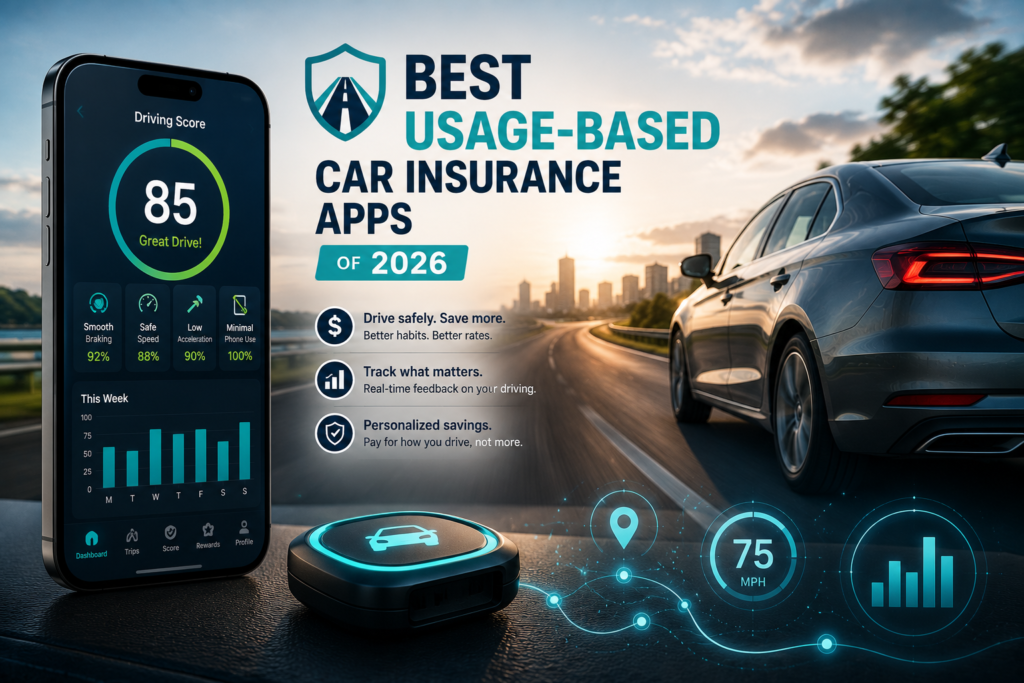
Usage-based insurance (also called telematics) uses a mobile app or plug-in device to track how, when, and how much you actually drive, then adjusts your premium based on that real data instead of relying purely on traditional rating factors like age and location. Around two in three drivers who enroll in a telematics program see their monthly premium go down, with a median savings of about $27 a month (roughly $324 a year) among those whose rates dropped. But not every program works the same way — some can only lower your rate, while others can raise it if your driving data looks risky. Here’s how the top options compare in 2026.
Quick Answer: Best Usage-Based Car Insurance Apps
| Program | Best For | Can Rates Increase? |
|---|---|---|
| Nationwide SmartRide | Best Overall / Highest Discount | No — discount only |
| State Farm Drive Safe & Save | Best for Young Drivers | No — discount only |
| Progressive Snapshot | Most Widely Available | Yes — can raise rates |
| Liberty Mutual RightTrack | Best for Privacy-Conscious Drivers | No — discount only |
| USAA SafePilot | Best for Military Families | No — discount only |
| GEICO DriveEasy | Best Feature-Rich App | Yes — can raise rates |
| Root | Best Tech-First, App-Based Insurer | Rate is set primarily by driving data |
| Farm Bureau | Best Overall Independent Rating | Varies by state program |
*Whether a program can increase your rate, and by how much, varies by state and specific policy terms — always confirm this directly before enrolling.
How Usage-Based Insurance Actually Works
It tracks specific driving behaviors. Most programs monitor some combination of hard braking, fast acceleration, mileage, phone use while driving, and nighttime driving (commonly defined as driving between midnight and 5 a.m.).
Some programs only apply discounts — they never raise your rate. Nationwide SmartRide, Liberty Mutual RightTrack, State Farm Drive Safe & Save, and USAA SafePilot are structured so your data can only help you, not hurt you — if your driving isn’t great, you simply don’t get the discount.
Other programs can increase your premium based on risky driving. GEICO DriveEasy, Progressive Snapshot, and Travelers IntelliDrive are examples of programs where genuinely risky driving detected through the app can raise your rate, not just withhold a discount — worth confirming before you enroll if this matters to you.
Savings are real but not universal. About two-thirds of enrolled drivers see a decrease in their monthly premium, with a median savings around $27 a month among those who do — meaning roughly a third of participants don’t see meaningful savings.
It’s different from pay-per-mile insurance. Telematics/usage-based programs primarily reward driving behavior, though some also factor in mileage. True pay-per-mile programs, like Allstate Milewise or Nationwide SmartMiles, price your policy directly based on how many miles you drive rather than how you drive.
Nationwide SmartRide — Best Overall / Highest Discount
Nationwide SmartRide offers the highest advertised discount of any major program: up to 15% just for signing up, and up to 40% off your premium at renewal if your driving data looks good. It tracks four factors — hard braking, fast acceleration, nighttime driving, and mileage — and importantly, Nationwide never uses the data to increase your rate. SmartRide ranked first in J.D. Power’s Auto Insurance Study specifically for usage-based insurance satisfaction.
Pros:
- Highest combined discount potential (up to 40% at renewal) among major programs
- Never increases your rate based on collected data
- Top-ranked for customer satisfaction with usage-based insurance specifically
Cons:
- Requires downloading a separate SmartRide app from Nationwide’s main app
- Not available in Alaska, Louisiana, or Massachusetts
Best for: Drivers who want the highest potential discount with zero risk of their rate increasing based on the data collected.
State Farm Drive Safe & Save — Best for Young Drivers
State Farm’s Drive Safe & Save program is now built directly into State Farm’s main app for most customers, simplifying enrollment, though its Steer Clear program — specifically for drivers younger than 25 — still requires a separate app. State Farm’s overall app also holds overwhelmingly positive reviews from over a million ratings.
Pros:
- Integrated into State Farm’s main app for most enrollees
- Dedicated Steer Clear program specifically for drivers under 25
- Discount-only structure — participation can’t raise your rate
Cons:
- Steer Clear still requires a separate app download for young drivers
- Discount amounts vary by state
Best for: Families with a driver under 25 who want a dedicated young-driver telematics program alongside the standard offering.
Progressive Snapshot — Most Widely Available
Progressive Snapshot is one of the most widely available usage-based programs, offered in nearly every state, and it factors in real driving data to adjust your premium. Unlike some competitors on this list, Snapshot can raise your rate if your driving data indicates higher risk, which is worth understanding clearly before enrolling.
Pros:
- Extremely wide availability across states
- Well-established program with a long track record
- Can meaningfully lower rates for genuinely safe drivers
Cons:
- Can increase your rate based on risky driving data, unlike discount-only competitors
- Customer satisfaction scores are solid but not top-tier
Best for: Drivers confident in their driving habits who want a widely available, well-established program.
Liberty Mutual RightTrack — Best for Privacy-Conscious Drivers
Liberty Mutual’s RightTrack program is built into the main Liberty Mutual app, letting you track your driving performance and score without a separate download, and it’s structured as a discount-only program — meaning your participation can only help your rate, never hurt it, which appeals to privacy-conscious drivers hesitant about telematics generally.
Pros:
- Integrated into the main app, no separate download required
- Discount-only structure protects against a rate increase
- Strong overall app functionality beyond just telematics
Cons:
- Maximum discount potential may be lower than Nationwide SmartRide’s top tier
- Tracking period and specific requirements vary by state
Best for: Drivers who want telematics savings with the reassurance that their rate genuinely cannot go up as a result.
If you’re exploring your options Best Car Insurance for Seniors of 2026
USAA SafePilot — Best for Military Families
USAA’s usage-based programs — SafePilot (rewarding safe driving) and SafePilot Miles (factoring in both behavior and mileage) — are powered by Noblr, a USAA-owned telematics platform. Like several other top programs, SafePilot only applies discounts and doesn’t raise rates based on the data collected.
Pros:
- Discount-only structure, consistent with USAA’s other member-friendly programs
- Choice between a pure behavior-based program (SafePilot) and one that also factors in mileage (SafePilot Miles)
- Strong overall customer satisfaction, consistent with USAA’s broader reputation
Cons:
- Membership eligibility limited to military-affiliated households
- Not an option for the general public
Best for: Eligible military-affiliated drivers who want a telematics option that can only help, never hurt, their rate.
GEICO DriveEasy — Best Feature-Rich App
GEICO’s broader mobile app is one of the most feature-rich in the industry, including an Easy Photo Estimate tool for repair estimates and a Vehicle Care feature (powered by CARFAX) that tracks service history and recalls. Its DriveEasy telematics program requires a separate DriveEasy Pro app and ranks third overall for customer satisfaction with usage-based insurance specifically, though the program can increase your rate based on risky driving data.
Pros:
- Extremely feature-rich main app beyond just telematics
- Ranks well for usage-based insurance customer satisfaction despite mixed app-specific reviews
- Strong overall discount lineup alongside the telematics program
Cons:
- DriveEasy can raise your rate based on risky driving, unlike discount-only competitors
- Requires a separate DriveEasy Pro app with more mixed reviews than GEICO’s main app
Best for: Drivers who want a feature-rich overall insurance app and are comfortable with a program that can adjust rates in both directions.
Root — Best Tech-First, App-Based Insurer
Root is a genuinely app-first insurer built around telematics from the ground up, rather than adding a program onto a traditional policy structure. Customers use Root’s app to track driving habits and mileage from the start, and this data directly shapes their personalized rate rather than functioning as an optional add-on discount.
Pros:
- Telematics is core to how Root prices policies, not an optional add-on
- Modern, digital-first customer experience
- Can offer strong pricing for genuinely safe, lower-mileage drivers
Cons:
- Less established track record than legacy national insurers
- Pricing model may not favor drivers with less consistent or higher-mileage habits
Best for: Tech-comfortable drivers who want an insurer built entirely around usage-based pricing from day one.
Farm Bureau — Best Overall Independent Rating
Farm Bureau earned a top independent rating for its usage-based insurance program in a recent broad analysis of 20 major insurers, evaluated across enrollment discount, maximum savings potential, rate competitiveness, and whether risky driving could increase premiums.
Pros:
- Top independent rating among usage-based insurance programs evaluated
- Competitive overall rates alongside the telematics discount
- Strong coverage and discount options beyond telematics alone
Cons:
- More limited state availability than the largest national carriers
- Program specifics vary by the state-based Farm Bureau affiliate
Best for: Drivers in Farm Bureau’s operating states who want a strongly rated, well-rounded usage-based program.
How We Chose These Programs {#how-we-chose}
InsureAtlas’s rankings are based on publicly available information: each program’s disclosed tracking factors, discount structure (whether rates can only decrease or also increase), maximum discount potential, and independent customer satisfaction data, including J.D. Power’s usage-based insurance rankings. No insurer can pay to appear higher on this list, and our rankings are not based on affiliate commission rates. Because savings depend heavily on your actual driving habits and the specific state-level program terms, we recommend confirming exact details directly with the insurer before enrolling.
What to Know Before Enrolling in a Telematics Program
Confirm whether the program is discount-only or can raise your rate. This is the single most important distinction between programs — Nationwide, Liberty Mutual, State Farm, and USAA’s programs can only help; GEICO, Progressive, and Travelers’ programs can also hurt.
Understand exactly what’s being tracked. Common factors include hard braking, fast acceleration, mileage, nighttime driving, and phone use — knowing what’s measured can help you understand what’s actually affecting your score.
Check the tracking period before assuming a discount is permanent. Many programs use an initial tracking period (commonly 90 days to six months) before finalizing your discount at renewal — an early estimate may not reflect the actual savings you’ll see.
Weigh privacy comfort against savings potential. If continuous tracking makes you uncomfortable, a discount-only program or one built into your main insurance app (rather than a separate download) may be an easier entry point.
Compare the app-based program against a true pay-per-mile option too. If you’re a low-mileage driver specifically, a pay-per-mile program like Allstate Milewise or Nationwide SmartMiles may produce better savings than a behavior-based telematics program alone.
Frequently Asked Questions
Can usage-based insurance actually raise my rate? It depends on the program. Some — including GEICO DriveEasy, Progressive Snapshot, and Travelers IntelliDrive — can increase your premium if your driving data indicates higher risk. Others, like Nationwide SmartRide, Liberty Mutual RightTrack, State Farm Drive Safe & Save, and USAA SafePilot, only apply discounts and never raise your rate based on the data collected.
How much can I actually save with usage-based insurance? About two-thirds of enrolled drivers see their premium decrease, with a median savings around $27 a month (roughly $324 a year) among those whose rate drops — though savings vary significantly based on your actual driving habits and the specific program.
What does usage-based insurance actually track? Most programs track some combination of hard braking, fast acceleration, mileage, nighttime driving (commonly midnight to 5 a.m.), and phone use while driving, depending on the specific insurer’s program.
Is usage-based insurance the same as pay-per-mile insurance? Not exactly. Usage-based/telematics programs primarily reward driving behavior (though some factor in mileage too), while true pay-per-mile programs like Allstate Milewise or Nationwide SmartMiles price your policy directly based on miles driven rather than how you drive.
Do I need a plug-in device, or does an app work? Most modern programs, including the ones on this list, use a smartphone app rather than a plug-in device, though older or state-specific versions of some programs may still offer a device-based option — check with your specific insurer.
Bottom Line
Nationwide SmartRide offers the strongest combination of high discount potential and a guarantee that your rate can’t increase, making it a strong default starting point for most drivers. Liberty Mutual RightTrack and USAA SafePilot (for eligible members) are solid alternatives with the same discount-only structure, while Progressive Snapshot and GEICO DriveEasy are worth considering if you’re confident in your driving habits and comfortable with a program that can adjust rates in both directions. Whichever program you’re considering, confirm upfront whether it’s discount-only or a two-way adjustment — that single detail matters more than almost any other feature on this list.
This article is for general informational purposes only and does not constitute financial, legal, or insurance advice. Program terms, tracked factors, discount amounts, and whether rates can increase vary by state and insurer, and are subject to change. Always confirm current program details directly with the insurance company or a licensed agent before enrolling.