
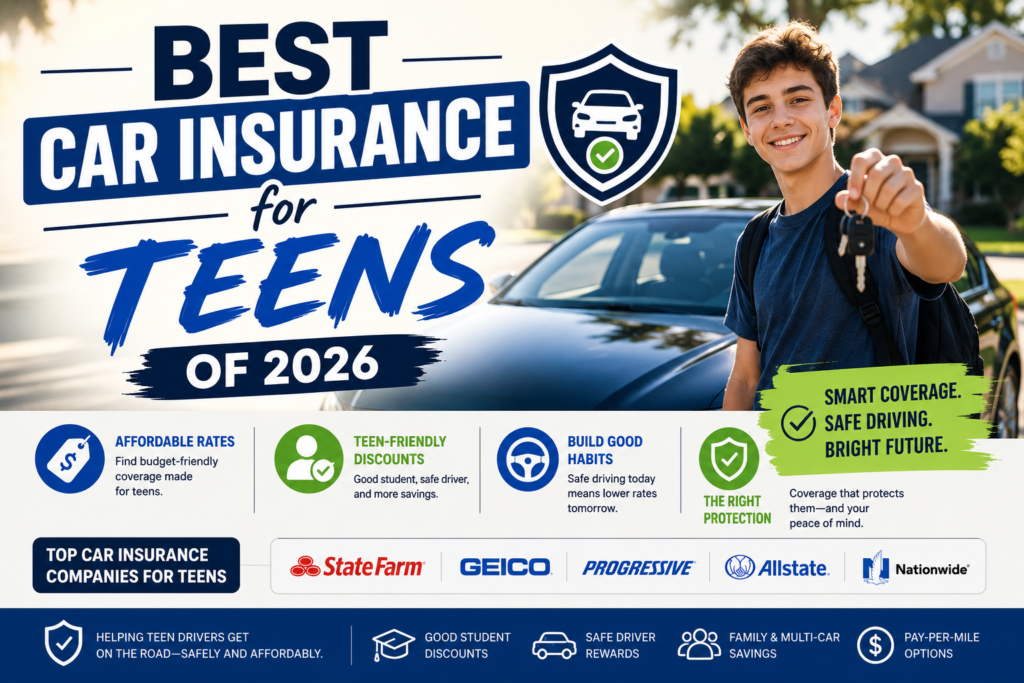
If you’re a parent shopping for insurance for a newly licensed teen, there’s one detail worth knowing before you compare a single quote: minors under 18 can’t legally sign their own insurance contract, so in nearly all cases, adding your teen to your existing policy — not buying them a standalone one — is both the legal requirement and, conveniently, the cheapest path. Here’s how the top insurers compare for families in this exact situation in 2026.
Quick Answer: Best Car Insurance for Teens
| Company | Best For | Notes |
|---|---|---|
| State Farm | Best Teen-Focused Programs | Steer Clear young driver program; strong satisfaction scores |
| GEICO | Best Affordability & Digital Tools | DriveEasy telematics app; multi-vehicle and new-car discounts |
| Amica | Best Family Service & Coverage Guidance | Recommends higher liability limits plus umbrella coverage |
| Liberty Mutual | Best Telematics-Based Savings | Strong usage-based discount program |
| Allstate | Best Driver Education Options | Discounts for completed driver’s ed courses |
| Erie | Cheapest for Adding a Teen | Frequently the lowest cost for parents adding a 16-19 year old |
| USAA | Best for Military Families | Some of the lowest teen rates for eligible members |
| Toggle | Best Digital-First Customization | Highly customizable, app-based coverage |
*Rates vary enormously by state, teen’s age, vehicle, and driving record — always confirm your actual quote directly with the carrier.
Why Adding Your Teen to Your Policy Is the Default Move
Teenagers under 18 legally cannot sign their own insurance contract, so a parent or guardian typically needs to be the policyholder, with the teen listed as a covered driver. Even for 18- and 19-year-olds who technically could buy a standalone policy, doing so is almost always far more expensive than adding them to an existing family policy — insurers spread the higher risk of a new driver across the household’s overall policy rather than pricing them entirely on their own.
Average annual estimates vary by analysis, but adding a 16-year-old to a parent’s full-coverage policy commonly runs somewhere in the $5,600-$5,800 range nationally, compared to considerably more for a standalone teen policy where available at all.
State Farm — Best Teen-Focused Programs
State Farm stands out for families who want a reputable insurer with strong customer satisfaction metrics and dedicated programs — including its Steer Clear young driver program — built around helping newer drivers build safer habits over time, not just pricing the risk and moving on.
Pros:
- Dedicated young-driver program aimed at building safer habits
- Strong overall customer satisfaction scores
- Extensive local agent network for guidance specific to first-time teen policies
Cons:
- Not always the single cheapest option compared with Erie or GEICO
- Rate increases have affected State Farm’s competitiveness in some states recently
Best for: Families who want a well-established insurer with structured programs for teaching safer teen driving habits.
GEICO — Best Affordability & Digital Tools
GEICO offers a generous multi-vehicle discount (commonly around 25%) that’s useful if your teen has their own car, plus a new-car discount (around 15%) if the vehicle is less than three model years old. Its DriveEasy telematics app lets teens (and parents) track driving habits and can earn savings of up to 25% based on demonstrated safe driving.
Pros:
- Strong multi-vehicle and new-car discounts
- DriveEasy telematics app rewards safe driving with meaningful savings
- Competitive base rates among national carriers
Cons:
- Customer satisfaction scores are more middling compared with State Farm or Amica
- Telematics savings depend on actual driving behavior, not guaranteed for every teen
Best for: Families who want strong discount stacking potential and a telematics app that rewards demonstrated safe driving.
Amica — Best Family Service & Coverage Guidance
Amica appeals to families willing to pay somewhat more for a service-forward experience, and it stands out specifically for the coverage guidance it offers households adding a teen driver — explicitly recommending against cutting corners on liability limits and suggesting an umbrella policy to protect family assets given the increased risk exposure. It also offers teen-relevant discounts, including young driver training, good student, student away at school, and in some cases a long-term «legacy» discount tied to a parent’s tenure with the company.
Pros:
- Proactive guidance on liability limits and umbrella coverage for teen households
- Wide range of teen-relevant discounts
- Strong overall service and claims satisfaction
Cons:
- Premiums tend to run higher than budget-focused competitors
- Not available in every state
Best for: Families who value thorough coverage guidance and are willing to pay somewhat more for a service-oriented experience.
Liberty Mutual — Best Telematics-Based Savings
Liberty Mutual offers a strong usage-based telematics program that can meaningfully reduce premiums for teens who demonstrate safe driving habits, giving cost-conscious families a data-backed way to lower the cost of insuring a new driver over time rather than relying purely on standard discounts.
Pros:
- Strong telematics-based savings potential
- 24/7 claims support
- Broad coverage options alongside the telematics program
Cons:
- Savings depend on actual driving behavior, which varies by teen
- Base rates before telematics discounts aren’t always the cheapest
Best for: Families who want a strong, data-driven path to lowering teen insurance costs over time.

Allstate — Best Driver Education Options
Allstate offers meaningful discounts for teens who complete an approved driver’s education course, making it a strong option for families prioritizing formal training as part of getting their teen on the road, alongside its broader accident forgiveness and safe-driving reward programs.
Pros:
- Strong driver’s education discount
- Accident forgiveness and Safe Driving Bonus programs available
- Established national insurer with broad availability
Cons:
- Premiums can run higher than budget competitors like Erie
- Complaint levels have historically been higher than top-ranked insurers
Best for: Families who want to be rewarded specifically for a teen completing formal driver’s education.
Erie — Cheapest for Adding a Teen
Erie frequently posts the lowest cost among evaluated insurers for parents adding a teen driver — particularly a 16- or 17-year-old — to an existing policy, making it one of the strongest starting points for cost-conscious families in the states where it’s available.
Pros:
- Frequently the cheapest option for adding a teen to a parent’s policy
- Strong overall customer satisfaction
- Solid discount for students living away at school without their car
Cons:
- Only available in a limited number of states
- Sold through independent agents rather than instant online quotes
Best for: Families in Erie’s operating states who want the lowest available cost for adding a teen driver.
USAA — Best for Military Families
USAA consistently posts some of the lowest rates for parents adding a teen driver among eligible military-affiliated families, and it’s also a strong option if your teen has already had a ticket or at-fault accident, since USAA tends to price high-risk profiles more favorably than many competitors.
Pros:
- Some of the lowest teen driver rates among eligible members
- Competitive even for teens with a ticket or accident on their record
- Pay-per-mile insurance option available for lower-mileage teen drivers
Cons:
- Membership eligibility limited to military-affiliated households
- Not an option for the general public
Best for: Eligible military-affiliated families, especially those whose teen already has a minor violation or accident.
Toggle — Best Digital-First Customization
Toggle (a Farmers-owned digital brand) offers highly customizable, app-based coverage that appeals to tech-comfortable families who want to adjust coverage details directly through an app rather than working with a traditional agent-based process.
Pros:
- Highly customizable coverage through a digital-first platform
- Modern app experience for managing the policy
- Flexible adjustments as your teen’s situation changes
Cons:
- Less brand recognition and track record than legacy national insurers
- Availability is more limited than major national carriers
Best for: Tech-comfortable families who want to manage and customize their teen’s coverage primarily through an app.
How We Chose These Companies {#how-we-chose}
InsureAtlas’s rankings are based on publicly available information: published rate analyses for parents adding a teen driver to an existing policy, third-party financial-strength ratings (AM Best), independent consumer satisfaction and complaint data, and each carrier’s disclosed teen-specific discount programs. No insurer can pay to appear higher on this list, and our rankings are not based on affiliate commission rates. Because teen driver rates vary enormously by state, vehicle, and driving record, we recommend getting quotes from at least three carriers before deciding.
What Parents Should Know Before Insuring a Teen Driver
Don’t just add the minimum required liability. Amica and other insurers specifically caution against cutting corners on liability limits when a teen driver is added — an at-fault accident involving a teen can expose the family’s assets well beyond a state’s minimum required coverage.
Consider a personal umbrella policy. Given the higher accident risk teen drivers statistically carry, an umbrella policy — often relatively inexpensive relative to the added protection — can provide an extra layer of liability coverage beyond your auto policy’s limits.
Ask about every teen-specific discount. Good student discounts, driver’s education discounts, student-away-at-school discounts, and multi-vehicle discounts can all apply simultaneously in many cases — ask your insurer to confirm which ones stack.
Consider a telematics program for both savings and peace of mind. Programs like GEICO’s DriveEasy or Liberty Mutual’s usage-based options can lower costs while also giving parents visibility into actual driving habits, which some families value beyond the discount itself.
Choose the teen’s vehicle carefully. A car with strong safety ratings and a lower repair cost will typically cost meaningfully less to insure than a sportier or more expensive vehicle — this can matter as much as which insurer you choose.
Frequently Asked Questions
Can a 16-year-old get their own car insurance policy? No. Minors under 18 can’t legally sign an insurance contract, so a parent or guardian must be the policyholder, with the teen listed as a covered driver on that policy.
Is it cheaper to add a teen to a parent’s policy or buy them a separate one? Adding a teen to an existing family policy is almost always significantly cheaper than a standalone policy, in addition to being the only legal option for drivers under 18.
What discounts are available for teen drivers? Common discounts include good student (typically requiring a B average or higher), driver’s education completion, student-away-at-school (for students who don’t keep a car at college), multi-vehicle, and telematics/usage-based programs that reward demonstrated safe driving.
Should I increase my liability coverage when adding a teen driver? Many insurance professionals recommend it, given the statistically higher accident risk of new drivers — some insurers, like Amica, proactively suggest higher liability limits and a personal umbrella policy specifically for households adding a teen.
When will my teen’s car insurance rate start to decrease? Rates generally decline steadily each year from age 16 through the early 20s, with a more noticeable drop around age 25 as insurers reclassify the driver into a lower-risk age bracket — the exact trajectory varies by insurer, gender, and driving record.
Bottom Line
Erie and USAA (for eligible military families) frequently offer the lowest cost for adding a teen driver, while State Farm and Amica stand out if you want structured programs and proactive coverage guidance alongside the policy itself. GEICO and Liberty Mutual are worth a close look if a telematics program could meaningfully lower your cost based on your teen’s actual driving habits. Whichever insurer you choose, don’t let the search for the cheapest premium crowd out the liability conversation — a new driver in the household is exactly the moment to make sure your coverage, not just your price, is where it needs to be.
This article is for general informational purposes only and does not constitute financial, legal, or insurance advice. Coverage availability, rates, and discounts vary by state, insurer, and individual driver profile, and are subject to change. Always confirm current policy details directly with the insurance company or a licensed agent before purchasing.