
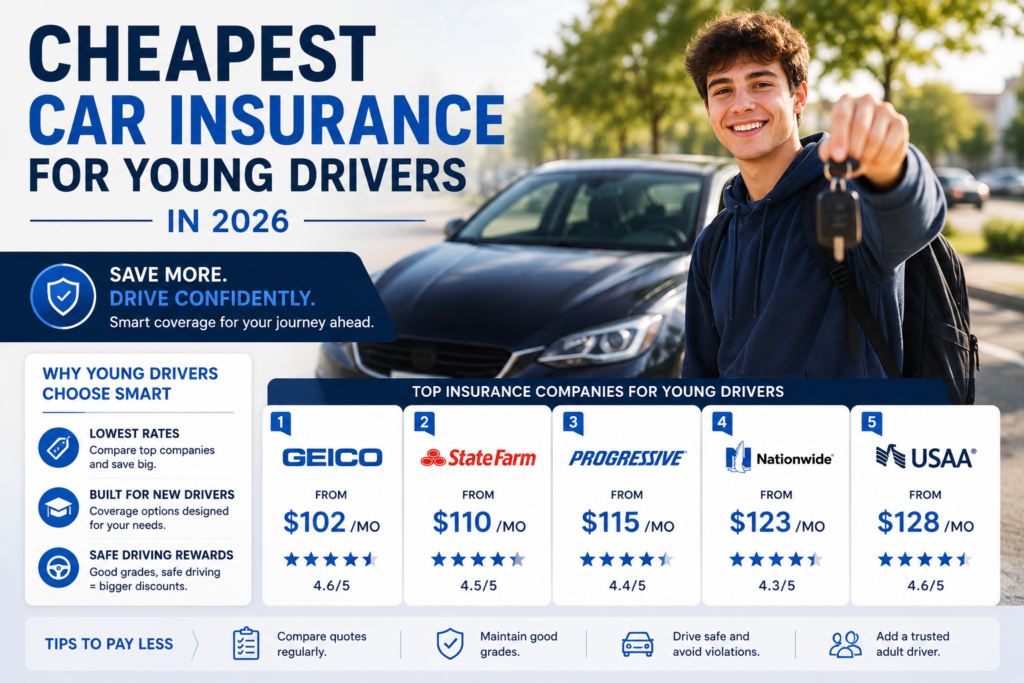
Young drivers pay more for car insurance than any other age group, and the gap is larger than most families expect: a 16-year-old averages around $10,387 a year for coverage, more than three times the roughly $2,600-$2,700 a typical adult driver pays. The good news is that which company you choose matters enormously here — one recent analysis found a $745-per-month difference between the cheapest and most expensive insurer for an identical 16-year-old driver profile, for identical coverage. Below, we compare the insurers that stand out for young drivers in 2026.
Quick Answer: Cheapest Car Insurance for Young Drivers
| Company | Best For | Notes |
|---|---|---|
| GEICO | Cheapest National Carrier | Cheapest national insurer for teens in many states; strong discount lineup |
| Erie | Cheapest Overall (Non-Military) | Lowest average teen rates among all carriers surveyed in independent analysis |
| Auto-Owners | Best Overall Company for Teens | Low rates plus lowest complaint volume in independent survey |
| USAA | Cheapest for Military Families | Lowest average rates for eligible members, if you qualify |
| State Farm | Best Telematics Discount Program | Drive Safe & Save program; up to 25% good student discount |
| Progressive | Best Usage-Based Program | Snapshot telematics program for careful, low-mileage drivers |
| Nationwide | Best for Staying on a Parent’s Policy | SmartRide telematics up to 40% off; strong multi-policy discounts |
| Farmers | Best for Under-25 Discounts | Good student and distant-student discounts |
*Rates vary enormously by state, age, gender, driving record, and vehicle — these reflect general patterns from industry analyses, not guaranteed quotes for your specific driver.
Why Young Drivers Pay So Much More
Drivers aged 16 to 19 have the highest crash risk of any age group, largely due to inexperience and underdeveloped driving skills rather than any single reckless behavior. Insurers price this risk heavily into premiums, and the cost drops steadily — though not overnight — as a driver ages and builds a track record:
| Age | Average Annual Rate (Full Coverage) |
|---|---|
| 16 | ~$10,387 |
| 18 | ~$514/month standalone (~$6,168/year) |
| 19 | ~$5,718 |
| 20 | ~$5,174 |
| 22 | ~$3,600-$3,900 |
| 25 | ~$1,800-$2,000 (with clean record) |
*Figures reflect general industry averages from multiple 2026 analyses and vary significantly by insurer, state, gender, and driving record.
GEICO — Cheapest National Carrier
GEICO is frequently the cheapest national insurer for teen drivers, and it’s the lowest-cost option in a majority of states according to recent rate analysis, though regional carriers occasionally beat it in specific markets. It offers a strong lineup of discounts relevant to young drivers, including a good student discount, a discount for students living away at school, and a driver’s education discount.
Pros:
- Frequently the cheapest national carrier for teen and young adult drivers
- Strong discount lineup specifically relevant to students
- Easy-to-use digital app and quote process
Cons:
- Customer satisfaction scores are more middling compared with insurers like State Farm
- Regional carriers occasionally beat GEICO’s rates in specific states
Best for: Young drivers who want the cheapest widely available national option with strong student-specific discounts.
Erie — Cheapest Overall (Non-Military)
Erie posts the lowest average teen driver rates among all carriers in a recent independent survey — cheaper even than most national brands — making it the strongest option for non-military families in the states where it operates. It also offers a distinctive discount for college students who leave their car at home while away at school.
Pros:
- Lowest average rates for teen drivers among surveyed carriers
- Distinctive discount for students who leave their car at home
- Strong overall customer satisfaction
Cons:
- Only available in a limited number of states
- Sold through independent agents rather than instant online quotes
Best for: Families in Erie’s operating states looking for the lowest available teen driver rates, especially with a student living away at school.
Auto-Owners — Best Overall Company for Teens
Auto-Owners combines competitively low rates for teen drivers with the lowest complaint volume among carriers evaluated in a recent independent survey, making it a strong overall pick if you want both affordability and a smooth customer experience.
Pros:
- Competitive rates specifically for teen and young drivers
- Lowest complaint volume among compared carriers
- Strong overall customer satisfaction
Cons:
- Only available in a limited number of states
- Typically requires working with an agent rather than an instant online quote
Best for: Families in Auto-Owners’ operating states who want the best overall combination of low rates and service quality for a teen driver.
If you’re exploring your options Best Car and Renters Insurance Bundle of 2026

USAA — Cheapest for Military Families
USAA consistently posts the lowest average rates for teen and young adult drivers among eligible members, standing out even against the cheapest national carriers. As with USAA’s other products, eligibility is limited to military members, veterans, and their immediate families.
Pros:
- Consistently among the lowest rates for young drivers, for eligible members
- Strong overall customer satisfaction
- Robust coverage customization options
Cons:
- Membership eligibility limited to military-affiliated households
- Not an option for the general public
Best for: Eligible military-affiliated families adding a young driver to their policy.
State Farm — Best Telematics Discount Program
State Farm’s Drive Safe & Save telematics program can save qualifying drivers up to 30% based on actual driving behavior, and it pairs well with a good student discount of up to 25% — a strong combination for young drivers who maintain good grades and drive carefully.
Pros:
- Strong telematics discount program (Drive Safe & Save) based on real driving behavior
- Generous good student discount (up to 25%)
- Extensive local agent network for hands-on guidance
Cons:
- Base rates before discounts are not always the cheapest among competitors
- Telematics discounts require opting into driving monitoring
Best for: Young drivers with good grades and safe driving habits who want to stack meaningful discounts.
Progressive — Best Usage-Based Program
Progressive’s Snapshot telematics program has saved qualifying drivers an average of around $322 a year based on actual driving data, making it a particularly strong option for careful, lower-mileage young drivers who can demonstrate safe habits.
Pros:
- Strong usage-based savings for careful, low-mileage drivers
- Well-known name-your-price shopping tool
- Competitive base rates in many states
Cons:
- Savings depend on actual driving behavior, so riskier drivers may see smaller discounts
- Customer satisfaction scores are solid but not top-tier
Best for: Young drivers with low mileage and cautious driving habits who want to prove it through a telematics program.
Nationwide — Best for Staying on a Parent’s Policy
Nationwide offers strong multi-policy discounts and a SmartRide telematics program that can save up to 40% for qualifying drivers, making it a good option for young drivers who join a parent’s existing policy rather than purchasing individual coverage — generally the more affordable path for most young drivers.
Pros:
- SmartRide telematics program with savings up to 40%
- Strong multi-policy and family plan discounts
- Broad availability across most states
Cons:
- Not available in Alaska, Louisiana, or Massachusetts
- Individual (standalone) policy rates are less competitive than family plan additions
Best for: Young drivers being added to a parent’s existing Nationwide policy rather than buying a standalone policy.
Farmers — Best for Under-25 Discounts
Farmers is frequently recommended specifically for drivers under 25, with average premiums that don’t run significantly higher than more experienced drivers pay, plus a good student discount and a distant-student discount for students living away at college without their car.
Pros:
- Competitive average premiums specifically for drivers under 25
- Strong good student and distant-student discount options
- Wide availability
Cons:
- Lower customer satisfaction scores in some independent surveys
- Tendency toward higher premiums than some competitors over time, even with a clean record
Best for: Drivers under 25 who qualify for good student or distant-student discounts and want a carrier built around that demographic.
How We Chose These Companies {#how-we-chose}
InsureAtlas’s rankings are based on publicly available information: published rate analyses across large samples of quotes for teen and young adult drivers, third-party financial-strength ratings (AM Best), independent consumer satisfaction and complaint data, and each carrier’s disclosed discount programs relevant to young drivers. No insurer can pay to appear higher on this list, and our rankings are not based on affiliate commission rates. Because rates for young drivers vary enormously by state, gender, vehicle, and driving record, we recommend getting quotes from at least three carriers — including at least one regional insurer if available in your state — before deciding.
How to Get the Cheapest Car Insurance as a Young Driver
Stay on a parent’s policy if possible. Joining a parent’s existing policy typically saves young drivers a substantial amount — often 60% or more — compared with buying a standalone policy, as long as you’re still eligible to be listed as a dependent driver.
Ask about every student-specific discount. Good student discounts (commonly requiring a B average or higher) and distant-student discounts (for students living a set distance from home without their car) can meaningfully lower your rate.
Consider a telematics/usage-based program. Programs like State Farm’s Drive Safe & Save, Progressive’s Snapshot, or Nationwide’s SmartRide can save careful, lower-mileage drivers a significant amount based on actual driving behavior rather than age alone.
Choose your vehicle carefully. A car with strong safety ratings and a lower repair cost can meaningfully reduce your premium — an expensive or high-performance vehicle will cost noticeably more to insure at this age.
Get quotes from regional carriers, not just national brands. Regional insurers like Erie or Auto-Owners sometimes beat national carriers significantly for young drivers in their operating states — don’t assume the biggest name is automatically the cheapest.
Frequently Asked Questions
Is it cheaper to have my teen on my policy or buy them a separate one? Adding a teen driver to a parent’s existing policy is almost always cheaper than a standalone policy — often by 60% or more — as long as the teen remains eligible to be listed as a dependent.
At what age does car insurance get cheaper for young drivers? Rates decrease steadily from age 16 onward, with a more noticeable drop around age 25, when insurers generally consider drivers to have reached a lower-risk category. The exact trajectory varies by insurer, gender, and driving record.
Do good grades actually lower car insurance rates? Yes. Most major insurers offer a good student discount, typically requiring a B average or higher, which can meaningfully reduce premiums for young drivers still in high school or college.
What is a distant-student discount? It’s a discount offered by several insurers for student drivers who attend school a set distance from home (commonly 100+ miles) and don’t keep their car with them — since the vehicle is driven less often, insurers price the risk lower.
Do telematics or usage-based programs actually save young drivers money? For careful, lower-mileage drivers, yes — programs like Snapshot, Drive Safe & Save, and SmartRide can produce meaningful savings based on actual driving behavior, though drivers with riskier habits (hard braking, late-night driving) may see smaller discounts or none at all.
Bottom Line
GEICO and Erie stand out as the cheapest widely available options for teen and young adult drivers, with Auto-Owners and USAA (for eligible military families) close behind on both price and service quality. If your young driver has good grades or drives carefully, stacking a student discount with a telematics program at State Farm, Progressive, or Nationwide can meaningfully cut the cost further. Whatever your situation, staying on a parent’s policy rather than buying standalone coverage, and getting quotes from at least three insurers including a regional carrier, are the two moves most likely to bring the cost down.
This article is for general informational purposes only and does not constitute financial, legal, or insurance advice. Coverage availability, rates, and discounts vary by state, insurer, and individual driver profile, and are subject to change. Always confirm current policy details directly with the insurance company or a licensed agent before purchasing.