
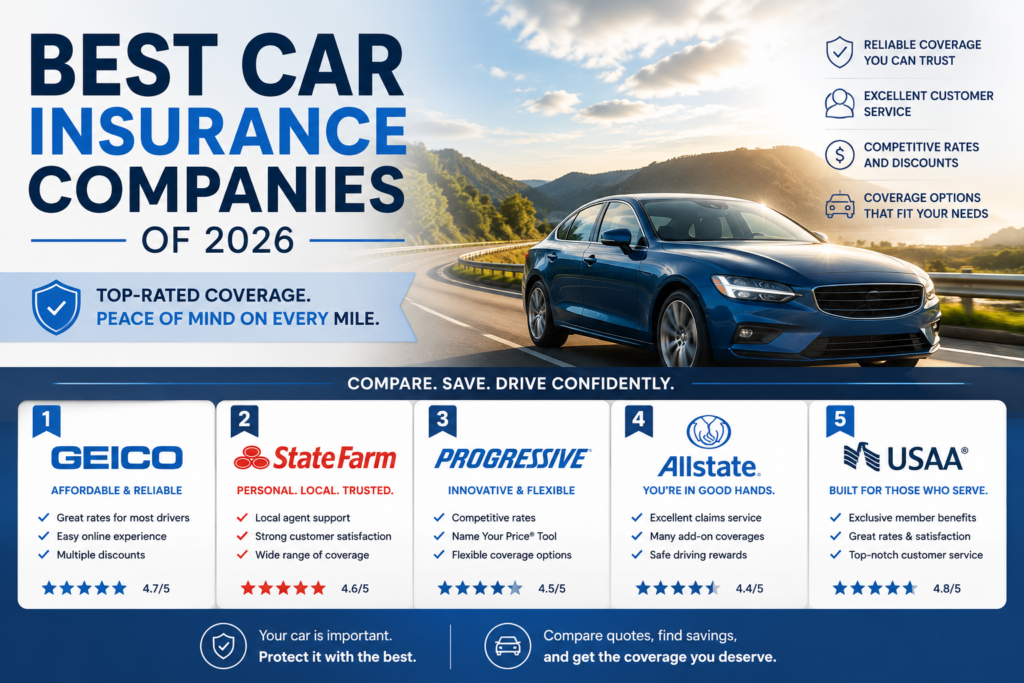
The average driver pays around $2,496 a year for full coverage car insurance in 2026 — about $208 a month — while minimum coverage runs closer to $912 a year. But that average hides a much bigger story: rates for identical coverage can differ by more than $100 a month between insurers, and the «best» company for a 22-year-old with a recent speeding ticket looks very different from the best fit for a 55-year-old with a clean 20-year record. Below, we compare the insurers that stand out in 2026 across price, coverage, and customer experience.
Quick Answer: Top Car Insurance Companies of 2026
| Company | Best For | Notes |
|---|---|---|
| Travelers | Best Overall | Lowest rates among top-ranked national carriers; A++ AM Best rating |
| GEICO | Best for Discounts | Wide range of discount opportunities; strong digital tools |
| Amica | Best Customer Satisfaction | Consistently top-ranked for claims handling |
| USAA | Best for Military Families | Lowest rates for drivers with accidents/tickets; deployment discounts |
| Progressive | Best Coverage Add-Ons & Customization | Strong optional coverage lineup; competitive in select states |
| State Farm | Best for Young Drivers | Strong discount and support programs for newer drivers |
| Auto-Owners | Best Regional Carrier | High customer satisfaction where available |
| Erie | Best Regional Value | Strong Price-Value Index; loyalty-focused service |
*Rates vary significantly by state, driving record, age, credit history, and coverage level — always confirm your actual quote directly with the carrier.
Why the «Best» Company Depends on Your Profile
No single insurer is best for every driver, and national rankings can even break down at the state level — for example, an insurer that ranks mid-pack nationally for affordability can be the cheapest option in a specific state due to local market pricing. A few factors that shift which company makes the most sense for you:
- Your driving record. Some insurers are noticeably more competitive for drivers with a clean history, while others (like USAA, for eligible members) post the lowest rates specifically for drivers with past accidents or tickets.
- Your age. Rates and available discounts for young or newly licensed drivers vary significantly by insurer — some companies build much more of their business model around this segment than others.
- Your state. Minimum coverage requirements, typical claims costs, and insurer pricing strategies all vary by state, which is part of why national rankings don’t always predict your cheapest local option.
- What coverage features matter to you. New car replacement, accident forgiveness, and rideshare coverage aren’t offered — or aren’t equally generous — across every insurer on this list.
Travelers — Best Overall
Travelers holds the top overall spot in multiple independent 2026 rankings, combining the lowest rates among top-ranked national carriers with the highest customer satisfaction score in its category. It also holds the highest possible AM Best financial strength rating (A++) and offers new car replacement coverage — a feature many competitors either don’t offer or cap at just two years.
Pros:
- Lowest rates among top-ranked national insurers
- Top-tier A++ AM Best financial strength rating
- New car replacement coverage available, uncommon among competitors
Cons:
- Doesn’t offer online purchasing — sold exclusively through independent agents
- Fewer specialty discount programs than GEICO
Best for: Drivers who want the strongest overall combination of low rates and customer satisfaction from a top-rated national insurer.
GEICO — Best for Discounts
GEICO consistently ranks among the top national insurers and stands out specifically for its wide range of discount opportunities, giving drivers numerous ways to lower their premium beyond the base rate. It also offers an easy-to-use digital platform for quotes and policy management.
Pros:
- Extensive discount options across multiple categories
- Easy-to-use digital and mobile app experience
- Competitive overall rates among national carriers
Cons:
- Customer satisfaction scores trail top performers like Amica in some surveys
- Coverage add-ons are less extensive than Progressive’s lineup
Best for: Drivers who want to maximize savings through discounts and prefer a fully digital experience.
Amica — Best Customer Satisfaction
Amica is a top pick across multiple independent 2026 analyses specifically for customer satisfaction, consistently ranking near the top of industry benchmarks for how well it handles claims — often the single most important factor once you actually need to use your insurance.
Pros:
- Consistently top-ranked for claims handling and customer satisfaction
- Strong financial strength ratings
- Good fit for bundling with Amica’s highly rated home insurance
Cons:
- Not available in every state
- Pricing is competitive but not always the single cheapest option
Best for: Drivers who prioritize claims experience and overall satisfaction above the lowest possible premium.
USAA — Best for Military Families
USAA posts the second-lowest average cost for good drivers among major insurers, and the lowest prices specifically for drivers with a history of accidents or speeding tickets — a rare combination. It also offers a 15% discount for garaging your vehicle on a military base, and savings of up to 60% if you store your car during deployment. Eligibility is limited to military members, veterans, and their families.
Pros:
- Frequently the lowest rates for drivers with accidents or tickets
- Military-specific discounts, including base garaging and deployment storage savings
- Robust coverage customization options
Cons:
- Membership eligibility limited to military-affiliated households
- Some customers report dissatisfaction with rising costs and claims processing times
Best for: Eligible military-affiliated drivers, especially those with a less-than-perfect driving record.
Progressive — Best Coverage Add-Ons & Customization
Progressive stands out for its strong lineup of optional coverage add-ons, giving drivers more ways to customize a policy to their specific situation than many competitors. Its pricing can also vary significantly by state — it ranks lower nationally for affordability overall, but tops the list in some individual states where local market pricing gives it an edge.
Pros:
- Strong optional coverage add-ons and customization options
- Highly competitive pricing in specific states
- Well-known name-your-price tool for budget-conscious shoppers
Cons:
- Not the cheapest option nationally in most states
- Customer satisfaction scores are solid but trail top performers like Amica
Best for: Drivers who want extensive coverage customization and are willing to check whether Progressive is especially competitive in their specific state.
State Farm — Best for Young Drivers
State Farm is frequently recommended specifically for young or newly licensed drivers, offering strong discount programs and a wide agent network that can be especially useful for families navigating a first policy for a teen driver.
Pros:
- Strong programs and discounts aimed at young drivers
- Extensive local agent network for hands-on support
- Solid bundling discounts with home insurance
Cons:
- Dropped in some national rankings recently due to rate increases
- Not always the cheapest option for experienced, older drivers
Best for: Families adding a young or newly licensed driver to their policy.
Auto-Owners — Best Regional Carrier
Auto-Owners is the best-ranked regional carrier in a recent independent analysis, with a near-perfect customer satisfaction score. It’s sold through independent agents rather than direct online quotes, but policyholders consistently report strong satisfaction with claims handling.
Pros:
- Highest-ranked regional carrier in recent independent analysis
- Strong customer satisfaction and claims handling reputation
- Comprehensive coverage options comparable to national carriers
Cons:
- Only available in a limited number of states
- Typically requires working with an agent rather than an instant online quote
Best for: Drivers in Auto-Owners’ operating states who want a highly rated regional alternative to the national brands.
Erie — Best Regional Value
Erie is a standout regional insurer known for strong value, loyalty-focused service, and competitive pricing where it’s available, frequently cited alongside Auto-Owners as a high-satisfaction alternative to the largest national carriers.
Pros:
- Strong Price-Value Index performance in independent analyses
- Loyalty-focused service and claims handling
- Competitive standalone rates even before bundling discounts
Cons:
- More limited state availability than national carriers
- Sold through independent agents, requiring a bit more shopping effort
Best for: Drivers in Erie’s operating states who want strong value and loyalty-focused service from a regional specialist.
How We Chose These Companies {#how-we-chose}
InsureAtlas’s rankings are based on publicly available information: published rate data across large samples of policies, third-party financial-strength ratings (AM Best), independent consumer satisfaction surveys, and complaint data reported to state insurance departments and the National Association of Insurance Commissioners (NAIC). No insurer can pay to appear higher on this list, and our rankings are not based on affiliate commission rates. Because car insurance pricing depends enormously on your state, driving record, age, vehicle, and credit history, we recommend getting quotes from at least three carriers before deciding — the national rankings above are a starting point, not a guarantee of your personal rate.
How to Choose a Car Insurance Company
Get quotes from at least three insurers. Rate differences of $100 or more per month for identical coverage aren’t unusual between insurers — comparison shopping matters more in auto insurance than almost any other purchase this size.
Check state-specific rankings, not just national ones. An insurer’s national ranking can break down entirely in specific states due to local market pricing — always get a real quote for your state rather than assuming a national «best» pick will also be your cheapest local option.
Confirm the specific coverage features you want are included. New car replacement, accident forgiveness, and rideshare coverage vary significantly by insurer — an overall top rating doesn’t guarantee your specific priorities are well covered.
Weigh claims satisfaction alongside price. The cheapest quote matters less if the insurer is slow or difficult to deal with after an actual accident — look at independent claims satisfaction data alongside your quote.
Ask about every discount you might qualify for. Bundling, good student, safe driver, multi-vehicle, and usage-based discounts can all meaningfully affect your final rate — insurers don’t always apply every discount automatically.
Frequently Asked Questions
What is the average cost of car insurance in 2026? Full coverage car insurance averages around $2,496 a year (about $208 a month), while minimum coverage averages roughly $912 a year (about $76 a month) — though your actual rate depends heavily on your state, age, driving record, and credit history.
Is the cheapest car insurance company always the best choice? Not necessarily. A low premium from an insurer with weak claims handling or poor customer service can be a worse deal in the long run than a slightly more expensive policy from a highly rated insurer — balance price against customer satisfaction and claims data.
Do I legally have to have car insurance? Nearly every state requires at least liability insurance to legally drive, with New Hampshire and Virginia being the primary exceptions (though both still have financial responsibility requirements). If you’re financing or leasing your vehicle, your lender will also typically require comprehensive and collision coverage.
How much can rates vary between insurers for the same coverage? Significantly — rate differences of $100 or more per month for identical coverage levels aren’t unusual, which is why comparison shopping across at least three insurers is one of the most effective ways to lower your cost.
How often should I shop around for car insurance? It’s worth re-shopping at each policy renewal, since insurers periodically adjust pricing and your own profile (driving record, credit, vehicle) changes over time — a company that was cheapest last year isn’t guaranteed to still be the best option today.
Bottom Line
Travelers stands out as the strongest overall pick for 2026, combining low rates with high customer satisfaction and a top-tier financial strength rating. GEICO is worth a close look if maximizing discounts matters most to you, while USAA remains hard to beat for eligible military families, particularly those with a less-than-perfect driving record. Whichever direction you’re leaning, get quotes from at least three insurers — the rate spread between companies for identical coverage is larger than most drivers expect, and the best national pick isn’t always the cheapest option in your specific state.
This article is for general informational purposes only and does not constitute financial, legal, or insurance advice. Coverage availability, rates, and discounts vary by state, insurer, and individual driver profile, and are subject to change. Always confirm current policy details directly with the insurance company or a licensed agent before purchasing.